This page introduces the story of the Whiteparish area between the coming of the first people into what is now Britain almost a million years ago and the present time, setting this within the context of wider geological and social changes. A brief summary is given here of Whiteparish in each period of time, with a general summary at the bottom of the page. A more detailed account of each period is on a linked page from each section, with these links also available as a list at the foot of this page.
This page uses a new index system that I intend to spread across the website. Click on any link in the list below to open that section. Click again to close, or simply open/close any or all sections as preferred.
Click any heading below to open that section (Introduction, Geology, etc.)
Introduction
All but 3000 years of the last million years were taken up by the Stone Age (Palaeolithic, Mesolithic and Neolithic) and Bronze age. There are no historical records but there is local archaeological material for these periods, allowing us a glimpse of the kind of lives the people might have led in this area. For the Iron age and Roman periods there is more local material but still no comprehensive historical record, but archaeology and Roman records start to give a more detailed picture of land use and the lives of people.
After the Romans departed various historical sources have come down to us, written from both Saxon and British points of view. These were passed down initially by word of mouth and written down only in later times, leaving a lot of scope for debate and historical dissent, with each new generation of historians keen to revisit these accounts and contribute their own interpretation. To provide a readable account here much of the dissent has been left out of this page - links and references are provided for the more searching reader to explore further. A few Saxon Charters have also come down to us, and some provide a more detailed local picture of parts of the parish.
Finally with the Domesday Book it starts to be possible to link people to places and be more definitive about what we see around us in the parish and how it relates to the past. By the Mediaeval period records are in no short supply and it becomes necessary to be selective. At the heart of this website is a detailed analysis of the 1842 Tithe Map and the comprehensive written account of the parish and wider Hundred left to us in Matcham's 1844 book. Attempts are made, using this data and analysis of what went before it, to push backwards the boundaries of what we can deduce for the Saxon period.
An archaeologist, Christopher Taylor, lived in the village in the 1970s and wrote some very useful papers on the development of Whiteparish in Saxon and Mediaeval times, and his work comes as both an inspiration and a warning. Later in his life he published an acknowledgement that many of the assumptions he made in these papers, especially with respect to specific dates, had proved inaccurate. [add specific reference to and text of this paper]. It is inevitable that the analysis in this website will also be improved on in the future. It should be seen as an attempt to capture as much detail as possible, given the present state of knowledge.
The geology under Whiteparish was laid down and eroded to roughly its present form before people came into the area
from 500,000 years ago, and has had a strong influence on land use.
The oldest formations under the parish are chalk from the Cretaceous period, laid down
under a deep sea between 84 and 71 million years ago (Newhaven, Culver, Spetisbury and Portsdown), the surface being eroded before subsequent layers were added.
On top comes the Lambeth Group: clay, silt and sand in this area (some gravelly), with small areas of Reading Formation at the top. This dates from 66 to
56 million years ago. The two most recent bedrock layers in the parish are the London Clay (56 to 34 million years ago) and Nursling Sand (66 to 23 million years
ago). [Very good geological charts at British Geological Survey. Link broken by 1.10.2022 - refind this page]
On top of these geological strata are areas of four superficial deposits: Clay with Flints (clay, silt sand and gravel with flints from chalk weathering - up to
5 million years old), Head (gravel, sand and clay poorly sorted and poorly stratified and formed mostly by solifluction and/or hillwash and soil creep - up to 3
million years old, and Alluvium (river deposits of clay - up to 2 million years old).
The village of Whiteparish itself lies mostly on the Reading Formation and London Clay (which is mostly sand along the Ashmore Lane and Common Road alignment).
Broadly the A36 crosses the formations at right angles, with the chalk the Pepperbox Hill - Dean Hill ridge forming the high ground. In the basin to the south
of this ridge the chalk is overlain, Newton Lane and Moor Lane running roughly along the Reading Beds and their boundary with the London Clay. The Commons areas
lie on London Clay, with areas of Nursling Sand above these in two stripes stretching towards the south of the parish, notably along the southern part of Common
Road and southwards along the A36, and parallel to this to the east across the Common.
Historically the chalk has been used for sheep downland, although in Iron Age and Roman times the light soils on the chalk ridge were used for arable farming.
Most of the open fields of the parish lie across the Reading Beds and Lambeth Group [confirm this in detail] and the heavy clay elements of the London Clay are
mostly still woodland, having formed the grazing and woodland areas for the various settlements.
Climate variation has strongly influenced the early story of the parish. In the Stone Age there were only people in the area during the last four interglacials: Cromerian, Hoxnian, Ipswichian and Holocene, the latter starting about 11,700 years ago and still going on today. Elephant and rhinoceros bones found in Castle Road Salisbury near West Wilts school came from a warmer period during the Palaeolithic period (500,000 to 10,000 years ago) and it has been warmer than today at times during the present Holocene Interglacial (the past 12,700 years).
Into the 12,700 years of the present interglacial have fitted the Mesolithic, Neolithic, Bronze Age, Iron Age, Roman period and the post Roman and Mediaeval periods right on to the present day. Even within this period the climate has warmed and cooled many times, with some examples being (see Wikipedia environmental timeline):
19,000 BC last glacial maximum and lowest sea level.
13,000 BC sea level rose 20 metres
9700 Bering land bridge from Siberia to North America disappeared
9000 to 5000 years ago Holocene climate optimum.
6500 BC English Channel formed
6200 BC Sudden cooling episode
6000 BC Climate maximum, with minimum glaciation and highest sea levels, the warmest period in the last 125,000 years. Ireland separated from Great Britain
2800 BC Climatic deterioration in Western Europe
225 BC The Sub-Atlantic period began (estimated on the basis of radiocarbon dating), characterized by increased rainfall, cooler and more humid climates
[Add changes before the Romans.]
From the ninth to fourteenth centuries the climate in Britain was significantly warmer than it is today [e.g. see this article ], a period referred to as the Mediaeval Warm Period.
The Little Ice Age then followed from 1250 to 1850 with significantly cooler temperatures that had a big impact on life in the area and a low point from 1500 to 1700.
1315-17 Great Famine (Europe)
1601 Coldest year in six centuries (volcanic eruption in South America)
Since about 1850 and the end of the Little Ice Age the climate has warmed, and may still be warming, although locally there has been a significant downturn in temperatures since the warm decade leading up to the millenium.
Changes in global temperature result in higher or lower sea levels, and the sea has been as much as 120 metres lower than today during recent glaciations and 20-40 metres higher than today in warm periods of interglacials. The higher parts of Whiteparish reach 150 metres above sea level over much of the Dean Hill/Pepperbox Hill ridge, while the lower parts fall to 35 metres along the eastern edge of Hayter's Wood (the Blaxwell part of Whiteparish Common) and at Melchet. This means that those parts of Whiteparish were at or near the high tide line during the last interglacial. The nick points on New Forest streams that resulted from the last fall in sea level are still very much in evidence and moving slowly upstream [reference University of Southampton]. [Wikipedia timeline of environmental history.] Changing sea level has left a fascinating series of features along the south coast of England, including submerged and raised cliff lines and submerged forests. A detailed account of sea level changes and observed features since the peak of the last Glacial 22,000 years ago can be found at Raised beaches.
The most recent period that brought the high tide line close to Whiteparish was during the Holstein interglacial between 340,000 and 325,000 years ago. At that time an inundated coastline left Whiteparish on a peninsula, with water up the Avon valley to Alderbury and westwards along the Dun valley to West Dean.
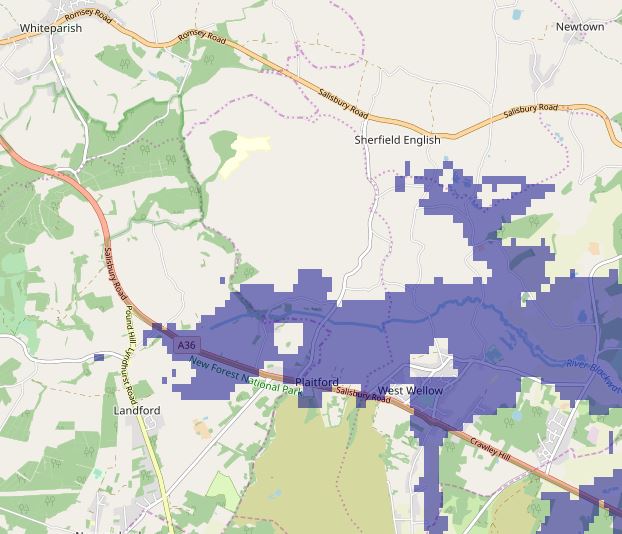
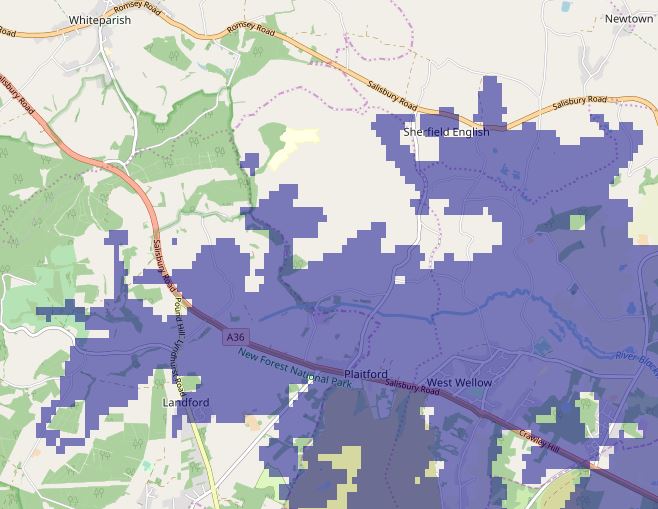
The lowest point in the present parish of Whiteparish is alongside Parkwater Cottage on Parkwater Lane, and this valley lies below 40 metres, within the tidal/beach zone between Chichester and Arundel in Sussex. Another low point lies just west of the A36 at Wicketsgreen Farm, and this valley crosses the detached portion of Whiteparish in Earldoms between North Common Farm and Northlands/Wickets Green. From Wicketsgreen Farm eastwards towards Plaitford and Wellow most of the line of the A36 would have been tidal salt marsh. Within Frustfield to the south and east of this point a large area is below 30 metres and was almost certainly salt marsh inundated at high tide at this time. This area includes the Blackwater valley through Landford and East Wellow. Another sea inlet crossed Melchet to the Whiteparish boundary. This reached and in places crossed the line of the A27 at the Whiteparish boundary and at a number of points between there and Sherfield English.
An approximate 30 metre sea level in the Whiteparish area from Flood.Firetree.net. This area would have defined the high tide line.
An approximate 40 metre sea level in the Whiteparish area from Flood.Firetree.net. This area is within the beach and cliff zone further east and may have been inundated occasionally
To the north of Whiteparish the 30 metre (high tide) line came to Lockerley, while the more exceptional 40 metre line reached West Dean. In the Avon valley the 30 metre contour reaches Woodgreen midway between Fordingbridge and Downton, and 40 metres reaches Fordingbridge.
This section is derived from this Wikipedia article, which includes a lot more detail, references and
various theories.
Up to about 450,000 years high ground linking Britain and France across the Straits of Dover formed a watershed. During the Anglian
glaciation water that would previously have flowed northwards collected behind ice damming the north sea and the large resulting lake broke through to escape
down the line of what is now the Channel. This and a similar later event in the period 340,000 to 240,000 years ago changed drainage patterns and set the scene
for the later formation of the English Channel.
The Last Glacial Maximum ended around 18,000 years ago, at which time the North Sea and much of the British Isles were covered with glacial ice and the sea level
was about 120 m (390 ft) lower than at present. As the climate warmed towards the Late Glacial Maximum around 12,000 BC Britain, much of the North Sea and the
English Channel were an expanse of low-lying tundra.
We know from evidence that includes the contours of the present seabed, that after the first main Ice Age the watershed between the North Sea and English Channel
extended east from East Anglia then south-east to the Hook of Holland, rather than across the Strait of Dover. The Seine, Thames, Meuse, Scheldt and Rhine rivers
joined and flowed west along the line of the English Channel as a wide slow river. At about 8000 BC the north-facing
coastal area of Doggerland (a name dating from the 1990s) had a coastline of lagoons, saltmarshes, mudflats and beaches as well as inland streams, rivers, marshes
and lakes.
As ice melted at the end of the last glacial period of the current ice age, sea levels rose and the land began to tilt in an isostatic adjustment
as the huge weight of ice lessened. Doggerland eventually became submerged, cutting off what was previously the British peninsula from the European mainland
by around 6500 BC. The Dogger Bank, an upland area of Doggerland, remained an island until at least 5000 BC. Key stages included
the gradual evolution of a large tidal bay between eastern England and Dogger Bank by 7000 BC and a rapid sea-level rise thereafter, leading to Dogger Bank
becoming an island and Great Britain becoming disconnected from the continent.
The prehistoric period covers the time between the first arrival of humans in what is now Great Britain and the start of written historical records in A.D. 43 [Wikipedia on Prehistoric Britain]. The main periods of Palaeolithic (Old Stone Age), Mesolithic (Middle Stone Age), Neolithic (New Stone Age), Bronze Age and Iron Age are described from a local viewpoint in the sections that follow. A brief introduction linking them together and with events in Europe can be seen here.
Cultural periods from the Old Stone Age (Palaeolithic) to the present [from
PastScape drop down box for periods on the advanced search page]
Palaeolithic 2.6 million years ago to 10,000 BC [Dates for periods modified from PastScape]
For more detail and references to the material quoted here see Palaeolithic.
In what has become a rapidly changing field in recent years, the earliest dated remains of Man in Britain found so far come from 900,000 years
ago in Norfolk and Suffolk. The next clearly dated remains are of Boxgrove Man in Sussex from about half a
million years ago. While no Palaeolithic finds have been recorded for Whiteparish itself, a scatter of finds from surrounding parishes show that
there were people in the area. The earliest dated finds come from Awbridge and Sherfield English from the lower Palaeolithic
(500,000 to 150,000 B.C., during the Cromerian Interglacial), and then from Fisherton Anger (Salisbury) from the upper Palaeolithic
(40,000 to 10,000 B.C. - Devensian Glacial). There is a wider range of undated Palaeolithic material including handaxes and other flintwork from
Downton and Laverstock and various locations in Salisbury. A related find was of bones of rhinoceros and elephant from this period in
Castle Road near the junction with Stratford road, Salisbury.
1.6m years ago humans were only found in Africa, although Neanderthals had already reached Europe.
The first Palaeolithic sites in Britain date from 900,000 years ago, on the coasts of Norfolk and Suffolk.
Fossilized human footprints found on a beach in Happisburgh, Norfolk, were dated to at least 800,000 years ago.
Bones of Homo heidelbergensis were found at Boxgrove in Sussex in 1993, a tibia (shin bone) and two teeth dated by surrounding
fauna to between 478,000 and 524,000 years old. Large numbers of hand axes of the period have been found there.
Britain has had four types of humans inhabit it: Homo antecessor, Homo heidelbergensis, Neanderthals and Homo sapiens. The latter three of those have
lived in Kents Cavern.
Human artefacts found in Kents Cavern in the nineteenth century were deduced to have possibly been half a million years old.
Neanderthals are thought to have appeared in the rest of Britain around 130,000 BC and became the dominant species until their disappearance
from the archaeological record c. 40,000 years ago [in
Wikipedia]. In context this means that Neanderthals were dominant right up to the most recent ice age, with Homo Sapiens only appearing
here in ???
A jawbone found in Kents Cavern has been dated as 41,000-44,000 years old making it the oldest Homo sapiens fossil found in North-West Europe.
At Kents Cavern, occupation since 40,000 years ago is thought to have been almost continuous.
The Red Lady of Paviland is a fairly complete Upper Paleolithic-era human male skeleton dyed in red ochre. At 33,000 years old it is
one of the oldest ceremonial burials of a modern human discovered anywhere in Western Europe.
24,500 Devensian glacial peak (or 21,000)
18,000-17,000 Deglaciation started in northern hemisphere after the last (Devensian) glaciation
Human occupation in southern Britain started about 15,500 - 14,000 years ago (thus 13,500 - 12,000 BC)
12,500 Abrupt sea level rise as Antarctic deglaciation started
For more detail and references to the material quoted here see Mesolithic.
The last glaciation of the present ice age ended about 12,000 years ago, defining the beginning of the Mesolithic period. Ice had reached its maximum extent about 8000 years earlier, when it covered the whole of Wales and extended southwards in the east over land now in the North Sea as far south as the Cromer Ridge along the Norfolk coast. The retreating ice left Britain joined to Europe and Ireland by an area known as Doggerland that is now part of the North Sea. To the east a deep channel divided it from Norway, while in the south the land joined with southern Sweden, attached along the full coastline from there to Brittany. A major river is believed to have run down the length of the Channel, fed by the Thames, Rhine and Seine, while a proglacial lake lay east-west from north of the Netherlands to northeast of Norfolk.
Detail from map above showing approximate coastline 16,000 (buff), 8000 (lime green), 7000 (dark green) and 5500 (yellow) years ago
[From Wikipedia map in Doggerland article]
The Mesolithic can be divided into two parts. In the first, with Britain connected to the continent, people and ideas such as ways of making tools flowed freely over a wide area. The people were hunters, armed with bows and arrows tipped with microliths, cutting down trees with flint axes and using tools of bone, antler and flint. Evidence from Yorkshire suggests the use of boats in this period. Food sources included red and roe deer, elk, aurochs and wild boar, as well as beaver, hare, hedgehog, pine marten, fox and badger, supplemented with hazelnuts, leaves, roots and seeds in what appears to have been a regular seasonal migration within a defined and limited area to access different foods at appropriate times of year. Between 8,000 and 7,000 years ago sea level rose to leave Britain separated from Europe and Ireland, and this second time period saw the development of distinctly different forms of material culture and marked regional innovations. During this time vegetation changed slowly and progressively from open grassland to widespread woodland.
The "Ancient Human of Occupation of Britain" project ran for ten years from 2001 and increased the number of known Mesolithic sites from 200 to 10,000, with a high density of settlements, at least in favourable areas. The population rose to new highs and Britain has been populated continuously ever since.
Locally, many Mesolithic finds have been found in the area of the later settlement alongside the river Avon at Castle Meadow, Downton in the third or fourth millenium BC (4000 to 6000 years ago). This area continued to be extensively used through the Neolithic, Bronze Age and Roman periods, although not it seems in the more unsettled parts of the Iron Age. Finds in the Stonehenge area hint at periodic use from 8500 to 4700 BC (10,500 to 6700 years ago), with the presence of worked stone from as far away as Wales and West Sussex leading to an interpretation that people were possibly congregating there [see Current Archaeology references on the Mesolithic page]. As well as many finds in Downton, Mesolithic implements have been found widely in the area, including in Salisbury, Laverstock, Clarendon, Petersfinger, Hamptworth and West Dean, and, of course, the Mesolithic [to be confirmed] arrowhead found in Great Dean field behind Meadow Court in the late 1990s and shown below.
.
Flint arrowhead found in Great Dean field behind Meadow Court at some time between c1995 and 2005
See further photographs on the Celtic Fields page.
[[This section doesn't really belong here, make sure the content is properly represented somewhere...]] The Castle Meadow site at Downton was also occupied in the late Neolithic and early Bronze Age
periods. Settlement in this area was probably continuous from late Neolithic times with farming in the river valley but in the more unsettled Iron Age the
construction of a defensive hill fort at Clearbury Ring on Clearbury Down [on the Downton/Odstock
boundary, overlooking the Avon: Clearbury Ring],
to the north-west, became necessary [this is surely improbable as Castle Meadow and Clearbury Ring were in different Iron Age tribal areas]. During the Roman
occupation some of the downs were ploughed
and a villa, built in the late 3rd or early 4th century A.D., controlled a large farming estate here. The villa was of medium size and the chief crops were
corn and pulses. There was a Romano-British settlement covering 20 acres in two enclosures on Witherington Down just outside the parish
(opposite Pepperbox Hill close to the hilltop). A field system covering 90 acres on the far side of the hill has been dated to the Iron Age (-800 to 43) and Roman
(43-410) periods.
[See the Thumbnail History section of the Wiltshire Council entry for Downton but I've
now collected comprehensive details here].
During the preceding Mesolithic period rising sea levels had cut Britain off from the continent and the Mesolithic hunter-gatherer culture had developed to an advanced stage; meanwhile, farming had spread through most of southern Europe during the period 6000 to 4000 BC. The Neolithic period saw the arrival of new ideas in the form of agriculture and sedentary living [Wikipedia Neolithic], although it is unclear whether these were brought by new settlers or simply adopted by natives, and not even agreed whether the change was gradual or rapid. It seems almost certain that plants and animals must have been brought from the continent by boat. The woods that now covered the island were ?progressively cleared to make room for farmland. New types of stone tools appeared, including polished tools.
Deforestation is known to have occurred around 5000 BC at Broome Heath in East Anglia, on the North Yorkshire Moors and on Dartmoor [is the New Forest a candidate too?], using stone axes and including by ring barking and burning. Between 3500 and 3300 BC many of these deforested areas saw reforestation and the development of larger settlements as communities centred themselves on the most productive areas, namely around the river Boyne in Ireland, Orkney and eastern Scotland, as well as Anglesey, the upper Thames valley, Wessex, Essex, Yorkshire and the river valleys of the Wash.
[Disassociated point] Neolithic houses were typically rectangular and made of wood - Wikipedia Neolithic British Isles].
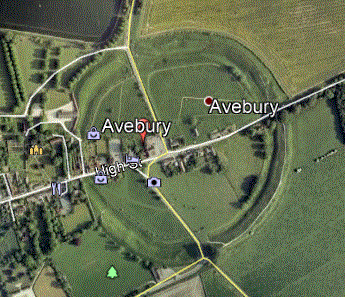
A wide variety of monuments were erected, many as megaliths - constructions of huge stones. Chambered tombs were constructed in the early and middle Neolithic periods mostly between 4000 and 3200 BC, and this was followed from 3300 to 900 BC in the late Neolithic and early Bronze Ages by the erection of stone circles - 1300 of these being known in northwestern Europe. Moving closer to home, Dorset has nine possible examples, but possibly dating from the Bronze Age and Devon at least six [Wikipedia List of stone circles and Stone circles in the British Isles and Brittany]. The best known and most impressive are those at Avebury (29 miles north-northwest of Whiteparish) and Stonehenge (14 miles northwest of Whiteparish), while there are none listed for neighbouring Hampshire. At Stonehenge, the outer earth bank and ditch date from about 3100 BC, while the first bluestones appear to have been raised between 2400 and 2200 BC, at the end of the Neolithic, although they may have been on the site as early as 3000 BC.
General overhead views of Avebury and Stonehenge [Google Earth]
Metal working using copper started in the British Isles about 3000 BC, first in Ireland then spreading to Britain [for instance Wikipedia Meldon Bridge Period].
Stonehenge lies less than 14 miles from the centre of Whiteparish in a northwesterly direction.
Thought to have been constructed between 3000 BC and 2000 BC, the earliest
phase of the monument, the surrounding circular earth bank and ditch, have been dated to about 3100 BC.
Radiocarbon dating suggests that the first bluestones were raised between 2400 and 2200 BC,
maybe having arrived at the site as early as 3000 BC. Further development occurred before the end of the Neolithic period in 2200 BC, but in view of the generally agreed overlap of the Neolithic and Bronze Age periods, the story of Stonehenge between 2600 BC an 2200 BC is covered under the Bronze Age, below.
Dates differ widely, for instance Wikipedia here has 2100 to 750 BC
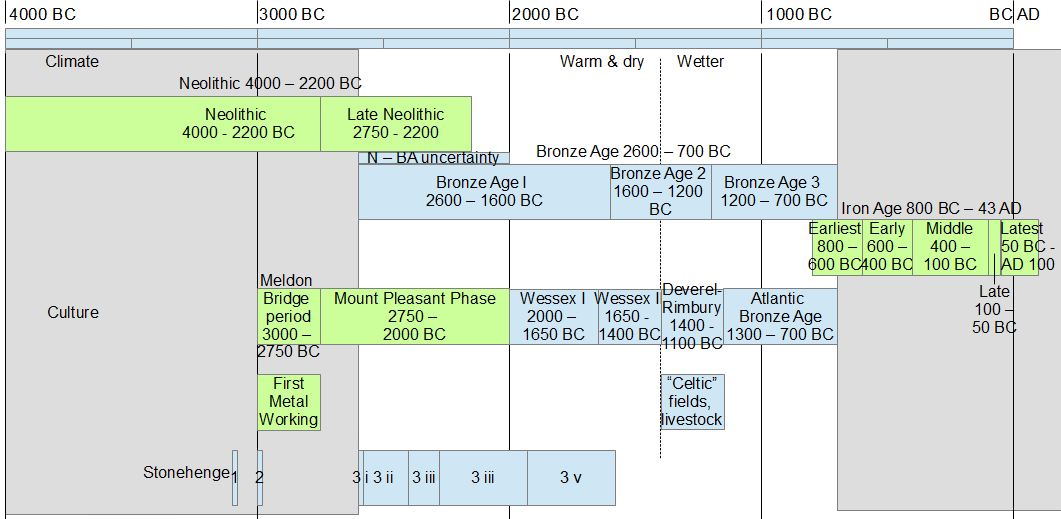
Bronze Age Timeline - [Period dates mostly from PastScape]
The transition from the Neolithic and Bronze Age is poorly defined, with suggested dates from as early as 2500 to as late as 2000 BC and with archaeology driving frequent revision of preferred dates by various workers in the field. It is broadly divided into Early (2500-1500 BC), Middle (1500-1000 BC) and Late (1000-700 BC), with each of these periods itself divided into two or three distinct phases [see this Wikipedia article].
The Beaker Culture at the start of the Bronze Age represented either an influx of new people or a wide spreading of culture across Europe from about 2700 BC, apparently peacefully, with many henge sites simply continuing in use. Development of a rich Wessex culture took place in southern Britain [clarify Beaker-Wessex]. The climate was deteriorating from warm and dry to much wetter conditions, resulting in the population moving from easily defended hilltop sites into more fertile valley locations. Large livestock farms developed in lowland countryside leading to economic growth and necessitating forest clearance. Devon and Cornwall became major sources of tin for much of Western Europe by the second half of the Middle Bronze Age (1400-1100 BC), and copper from north Wales. Tribal societies grew in complexity. The early Bronze Age was characterised by individual burial in barrows (tumuli) or cists; later in the Bronze Age many of these were reused as cremation cemeteries.
In the Bronze Age farming was extensive across Britain, and the area around Whiteparish is no exception. Celtic fields across Witherington Down and Pepperbox Hill cover some 520 acres and would have supported a substantial population if they were all used at once, which seems probable [explore further evidence and possibility of continued expansion of the area through or into the Roman period]. Within this area on the ridge at the foot of Pepperbox Hill an enclosure contains large numbers of quarry pits, with more outside it, 153 of them in all, almost certainly flint mines in the chalk. For comparison the Neolithic Grime's Graves in Norfolk has 433 known pits and possibly more in the adjacent woodland area. There are Bronze Age barrows and other signs in most of the adjacent parishes, indicating a widespread population, although it seems probable that much of the wetter ground in the parish was forested rather than farmed.
2600 - 1600 BC Early Bronze Age [2600 Pastscape, 2100 Wikipedia]
1600 - 1200 BC Middle Bronze Age - Deverell-Rimbury culture starts emerging in second half
1200 - 700 BC Late Bronze Age
3000 - 2750 BC Meldon Bridge period of the Neolithic, divided on the basis of metalworking into Stage I Castletown Roche industries and Stage II Mknocknague/Lough Ravel industries
2750 - 2000 BC Mount Pleasant period of the Neolithic [Wikipedia here]. Divided into the Frankford industries, the Migdale-Marnoch industries and the Ballyvalley-Aylesford industries. Beaker pottery appears with copper and gold. (Overton period follows.)
2500 - 2000 BC Overlap uncertainty between Neolithic and Bronze Age [Wikipedia here]
2000 - 1650 BC Wessex I, later phases of Stonehenge (second and third phases)
1650 - 1400 BC Wessex II
1400 - 1100 BC Deverel-Rimbury culture (Dorset) - "Celtic" fields, palisaded cattle enclosures and cremation burials either in urnfield cemeteries or under low, round barrows. Livestock farmers.
c 3100 BC Stonehenge 1 [Stonehenge dates from Wikipedia here]
c 3000 BC Stonehenge 2
c 2600 BC Stonehenge 3 I
2600 - 2400 BC Stonehenge 3 II
2400 - 2280 BC Stonehenge 3 III
2280 - 1930 BC Stonehenge 3 IV
1930 - 1600 BC Stonehenge 3 V
[Add map here of finds in this and adjacent parishes]
An article that covers a lot more than just the bronze age - worth reading
more carefully.
The earlier view that the Celts spread out from central northern Europe and crossed to Britain in the Iron Age
has been challenged in recent years with a new concept that
the Celts originally occupied the western fringes of Europe and spread inland across the continent from there. The more modern
interpretation has Celts occupying at least the western
parts of Britain. Whichever starting point is adopted, it is generally accepted that the Iron Age saw successive waves of new people crossing
the Channel and "invading, migrating or diffusing" into Britain.
Extensive field systems, often described as "Celtic" fields were being put in place from the late Bronze Age, with settlements becoming more permanent.
Such fields are found on Witherington Down and Standlynch Down [reference], and [reference] along the top of Pepperbox Hill.
Long ditches, some many miles in length, were dug with enclosures placed at their ends, and Grim's Ditch and Bockerley Dyke, running in sections
along parts of the Hampshire, Wiltshire and Dorset borders are thought to have originated in the late Bronze Age or early Iron Age.
These are thought to indicate territorial
borders and increased control of areas of land. By or at [resolve] the 8th century BC at the beginning of the Iron Age,
there is increasing evidence of Great Britain becoming
closely tied to continental Europe, especially in Britain's south and east. Trade by sea increased, including Phoenicians from the
Mediterranean.
The first hill forts in "Wessex" date from the late Bronze Age, but became common only in the period from
550 to 400 BC, which may indicate a particular period of some instability. Locally there are hill forts at Dunwood Manor, [add some more],
although the fields on Witherington Down and further off in Castle Meadow at Downton are not known to have been protected by a nearby hill
fort, although Castle Meadow itself was abandoned [link]. There was an enclosed Iron Age settlement at Highfield
in Salisbury (immediately north of the A36 just west of the Castle roundabout).
Firmer detail is known from towards the end of the Iron Age period. There is known to have been an invasion of Belgae from the end of the
second century BC, and in Caesar's Commentaries on the Gallic War [check when he wrote], he recorded that the Britons further inland
than the Belgae believed that they were indigenous.
Earlier in the Iron Age [but of unspecifed date], this part of Britain was occupied by a British tribe, Caer Gwinntguic, with Caer
Baddan to their northwest
on the Severn estuary. The arrival of the Belgae in the late 2nd century BC has been described as an
invasion" according to [from Wikipedia]. While Whiteparish came
within the territory of the Belgae tribe, this was related
to the Atrebates and Regini [sp], and coin evidence suggests that the whole of this area was under Atrebates rule.
Further detail and more comprehensive references can be found at Iron Age.
Although having no direct impact themselves on Whiteparish, Julius Caesar's invasions of Trinovantes territory in Essex and south Suffolk
in 55 and 54 BC increased Roman control in southern England and provided some British tribes with links that were to lead ultimately to the
invasion by Claudius a hundred years later in 43 AD.
Shortly before Julius Caesar's invasion of Britain in 55 and 54 BC, the Trinovantes were considered the most powerful tribe in
Britain. At this time their capital was probably at Braughing (in modern-day Hertfordshire). In some manuscripts of Caesar's
Gallic War their king is referred to as Imanuentius, although in other manuscripts no name is given. Some time before Caesar's
second expedition this king was overthrown by Cassivellaunus, who is usually assumed to have belonged to the Catuvellauni. His son,
Mandubracius, fled to the protection of Caesar in Gaul. During his second expedition Caesar defeated Cassivellaunus and restored
Mandubracius to the kingship, and Cassivellaunus undertook not to molest him again. Tribute was also agreed.
[From this Wikipedia article - more detailed links follow.]
In common with other regions on the edge of the empire, Britain had enjoyed diplomatic and trading links with the Romans in the century since
Julius Caesar's expeditions in 55 and 54 BC, and Roman economic and cultural influence was a significant part of the British late pre-Roman Iron Age,
especially in the south.
By the 40s AD, the political situation within Britain was apparently in ferment. The Catuvellauni had displaced the Trinovantes as the most
powerful kingdom in south-eastern Britain, taking over the former Trinovantian capital of Camulodunum (Colchester), and were pressing their
neighbours the Atrebates, a client kingdom ruled by the descendants of Julius Caesar's former ally Commius. As elaborated below, Verica, the exiled king of the
Atrebates,
appealed to Rome for support, apparently leading to the Roman invasion. This then starts to have an impact locally, as the Atrebates had closely allied tribes
in the Regini in Sussex and the Belgae, whose territory included the Whiteparish area. With the Atrebates, Regni and Belgae [presumably?] under Verica, the
Romans met no resistance to their westward movement until they crossed into Dorset and the territory of the Durotriges.
Further detail and more comprehensive references can be found at The Romans.
When the Romans arrived they initially kept the Iron Age tribal areas, and maintained "supportive" Iron Age leaders in their posts for their
lifetimes before making any
changes to administrative structures. The Wikipedia entry for the Roman Conquest and the map
in it of campaigns between 43 and 60 AD, suggests that the Romans arrived in this area by 47 at the latest. One of the consequences of this was the
continuation of Iron Age settlements as Romano-British settlements right through
the Roman period, which is what happened on Standlynch Down, just outside the parish across the A36 from Pepperbox Hill.
While there are villas in the Dun valley and and Downton [links], here in Whiteparish arable farming from the Standlynch Down settlement
continued along the ridge of Pepperbox Hill. Such settlements were important contributors to the Roman economy, trading grain that
led to Britain being described as the breadbasket of the Roman Empire [link].
The Romano British tribal areas that emerged at the end of the Roman period reflected the earlier Iron Age structure,
modified by the changes made under the Romans. Before the Roman conquest [right term?] the Belgae, invading from the continent, had established themselves
in this area, presumably with the Atrebates moving northwards ahead of them?
From BritainExpress.com The exiled king of the Atrebates appealed to
Rome for support, leading to the Roman invasion. Caratacus, king of the Catavallauni [sp?] tribe invaded Atrebates territory, and Verica, king of the Atrebates,
"fled" to Rome and appealed for help. [Presumably the Romans helped him and in due course returned to him the lost territory?] Caratacus was captured in 51:
From HistoryOnTheNet [this website won't open in a frame - open in new tab]
Caratacus' guerrilla force was joined by other tribes who resisted Roman conquest. and confronted the Romans near the River Severn.
However, Caratacus was defeated. He escaped again and sought shelter with the Brigantes tribe. However their Queen, Cartimandua betrayed him to the Romans.
Caratacus, his family and other rebels were taken prisoner and sent to Rome. In Rome Caratacus was pardoned by Claudius and allowed to live out his days in Italy.
From BritainExpress.com, continued: The fight in the South -
Vespasian's 2nd Legion marched through Sussex and Hampshire, the lands of the Atrebates, who were friendly to Rome, meeting their first real opposition
from the Durotriges tribe in Dorset. They overran the hill fort of Hod Hill, and in an unusual move, built their military camp in one corner of the
enclosure, where it can be seen today. Then they pushed on to present day Exeter, capturing twenty hill forts in all.
From BritainExpress.com, continued: Maiden Castle -
A grim reminder of this invasion is still to be seen at Maiden Castle in Dorset, where the Romans left behind a war cemetery full of enemy remains. The
Celtic inhabitants had attempted to defend the fort with the aid of some 54,000 sling stones brought up from Chesil Beach, but this primitive artillery was no
match for the discipline and experience of the Roman legions.
From Wikipedia Vespasian: Invasion of Britannia (43)
Upon the accession of Claudius as emperor in 41, Vespasian was appointed legate of Legio II Augusta, stationed in Germania, thanks to the influence of the
Imperial freedman Narcissus. In 43, Vespasian and the II Augusta participated in the Roman invasion of Britain, and he distinguished himself under the
overall command of Aulus Plautius. After participating in crucial early battles on the rivers Medway and Thames, he was sent to reduce the south west,
penetrating through the modern counties of Hampshire, Wiltshire, Dorset, Somerset, Devon and Cornwall with the probable objectives of securing the south
coast ports and harbours along with the tin mines of Cornwall and the silver and lead mines of Somerset.
[Wikipedia cont] Vespasian marched from Noviomagus Reginorum (Chichester) to subdue the hostile Durotriges and Dumnonii tribes,[10] captured twenty
oppida (towns, or more probably hill forts, including Hod Hill and Maiden Castle in Dorset). He also invaded Vectis (now the Isle of Wight), finally setting
up a fortress and legionary headquarters at Isca Dumnoniorum (Exeter). During this time he injured himself and had not fully recovered until he went to Egypt.
These successes earned him triumphal regalia (ornamenta triumphalia) on his return to Rome.
In wider terms Britain had been divided into Roman Provinces not unlike the British regions today, with Brittannia Prima in the southwest and Maxima
Caesariensis in the southeast meeting at a boundary equivalent to the present Hampshire/Sussex border in the Emsworth area. Whiteparish fell clearly
into Britannia Prima. See this map in EarlyBritishKingdoms.com.
Further detail and more comprehensive references can be found at The Romans.
Introduction to the Anglo-Saxon period (410 to 1066)
Who were the Angles, Saxons and Jutes? See here [but there is now more information on this page than there,so possibly incorporate that material here and remove that page].
[Break added above to align title correctly when linking from another page - is there a better way of doing this?]
By the year 383 the Romans had withdrawn from the north and west of Britain, and by 410 [?411?] attempts by the remaining Roman military to
maintain Roman control came to and end and the Emperor Honorius told the British people to look to their own defence. This appears to have
resulted in the loss of central government, with tribal areas becoming independent while still maintaining Roman style law and order as
before. The result was the return of control in this area by the Atrebates. To the west of the river Avon and south of the Wylye was
Dumnonia, occupied by the Durotrigies [check and clarify] [refer to map].
Initially life appears to have continued much as before, but Saxons, Angles and Jutes [confirm] were already pressing the eastern parts of
southern Britain, and Vortigern, the apparent overall British leader [expand] welcomed the Jutes under the brothers Hengist and Horsa as friends
and gave them
the Isle of Thanet in 447. Within ten years they had largely driven the Britons out of Kent. This pattern was being repeated elsewhere round the coast and northern boundary of Roman Britain, with the Picts raiding southwards down the east coast from "Scotland" and the Scoti from Ireland raiding the coast of Wales and the southwest of "Scotland" [better identity needed]. Urban life seems to have collapsed progressively across the country - by 450 in Winchester, with Saxon cemeteries established in the 6th and 7th centuries, 500 in Silchester... [and add more local examples].
In the south, after Kent, Sussex was the next area to be taken, with Ælle arriving with his sons Cymen, Wlenking and Cissa in 477 on
the Selsey peninsula. Again, progress was rapid, and thirteen years later, in 490, they had crossed Sussex to Pevensey [Andred], driving out the
Britons. The distribution of early "ing" place names along the coast and up the rivers, which were at that time broad open tidal estuaries, suggests that this invasion may have been water-based, which we will see is plausible in this area too, where a second phase of settlement reached across the area from the north end of Southampton Water to Charford, some ... miles up the Avon, both being north of the Jutes in the New Forest.
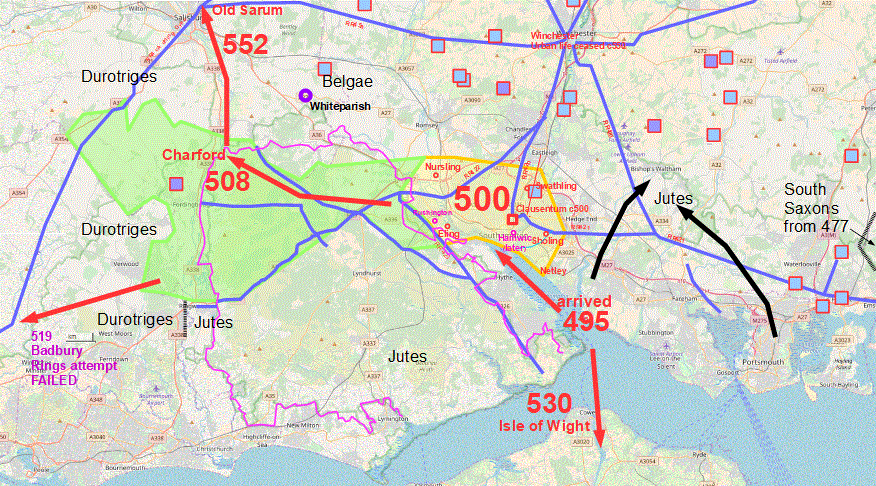
Wessex was the third and final area to be attacked and settled on the south coast, although progress proved very different and much slower here. According to ASC Cerdic and Cynric arrived with five ships in 495 at Cerdic's-ore, probably on the coast near Netley Marsh [reference]. Later, in 514 (519 in Asser), the West Saxons, with Stuf and Wihtgar, came to the same place (Cerdic's-ore) with three ships and also fought the Britons. Cerdic undertook the government of the West Saxons in 519 (ASC time). Porta and his sons Beda and Mela (see Jutes below [link]) came to Portsmouth in 501 and seem to have become or merged with Jutes called the Meonware in the region from there to the river Meon. By 508, and quite possibly in 501 [see Æthelweard for 500] Cerdic and Cynric had reached the Salisbury Avon, but this was a tribal boundary, and crossing it held them up until 625 or 658. Cerdic was then king of the West Saxons from 519 until his death in 534.
In 519 Cerdic tried to cross the Avon at Charford, but was held off by the Durotrigies. Some form of peace treaty appears to have been reached,
and the boundary here held. The West Saxons under Cerdic made no further recorded progress west, and none north for a further 30 years,
a situation that resonates rather well with the descriptions by Gildas of peace for a
generation following the battle of Mount Badon. Unable to expand west or north [it's not clear whether they had reached Winchester at this
stage], they turned their attention to the Jutes to the east and south, the Ytene in the New Forest and along the Forest coast, the Meonwara in the Meon valley, and the Jutes on the Isle of Wight. Since these areas were described as peopled by Jutes at a much later date [date and reference], this appears to have been a case of making them subject to the West Saxons rather than driving them out. Taking these areas into the emerging West Saxon kingdom consolidated what would later be known as Wessex southwards to the New Forest coast, across the Solent to the Isle of Wight and eastwards to the Sussex boundary, but not yet northwards as far as Salisbury or [probably] Winchester. This remained the situation up until 552.
Although some 500 years had already passed since the Roman Conquest, the new tribal boundaries show a striking resemblance to those of the Iron Age before the Romans arrived, suggesting that tribal allegiances and sense of identity had remained strong within the Romano-British communities right through the Roman period and that there was a willingness to defend those earlier boundaries. The West Saxons from the south were moving progressively into what had been the Belgae area before the Roman conquest, the South Saxons had taken the area occupied by the Reginenses before Roman times, and the Thames Valley Gewissa [suitable term?] were taking the Atrebates area south of the Thames. The Belgae, Reginenses and Atrebates were descendants of invaders who had arrived in the Iron Age about 100BC as the Romans advanced across their tribal areas on the North Sea coast of the continent [link], and appear to have been a confederation of tribes, possibly reflecting the advantages of mutual support in defending themselves from the native Britons around them. On the other hand the Dumnoniae in the southwest beyond the river Avon had been native Britons. [non sequitur...] At the Roman Conquest the Belgae, Reginenses and Attrebates had been pro-Roman and were therefore occupied peacefully, whereas the Romans took Dumnonia by force, hillfort by hillfort [add links back to the Romans and Iron Age].
Now, as the West Saxons attempted to advance, Dumnonia defended their boundary successfully until 625 or even possibly 658 [repeated somewhere
close by],
while Wessex expanded northwards to meet the Gewissa coming south, then together westwards to the Bristol Channel and eastwards into [?] Surrey
and Berkshire [this later after Ine?], together taking control of the entire Attrebates territory and driving the native Britons out, as well as
dividing the Dobunni
into a tribal area north of Gloucester roughly in Gloucestershire, Herefordshire and Worcestershire [check] and one on the Bristol Channel
roughly in Somerset. West Saxon control over Somerset and Dorset followed by 658, Devon by 726 and finally Cornwall in 838. In a sense this
marks the end of the expansion of Wessex, as together with Mercia, Sussex, Kent, Essex, East Anglia and Northumbria, the British mainland
was now occupied by Anglo-Saxon kingdoms (the Heptarchy) and further expansion would only take place by different mechanisms.
The following sections examine the Anglo-Saxon period in more detail.
After the Romans left in 410 Jutes settled in Kent (Cantaware), possibly around Hastings (Haestingas), in the Meon valley (Meonwara), in the New Forest (Ytene) and on the Isle of Wight (Wihtwara, Uictuarii in Latin). Although the Ytene and Meonwara are shown on the map below as mixed Saxon/Jute there is no reason to suppose they weren't initially simply Jutish settlement. [Draw a map specifically for this period]
(Later) 575 Jute settlement areas in southern Britain in red (from Wikipedia)
The Jutes are normally considered to have come from Jutland. Bede described them as coming from the north part of Jutland, labelled Teutones on the first map below, using the description that their homeland was on the other side of the Angles relative to the Saxons. The second map, from Wikipedia shows more precisely that their origins were on the Baltic coast side of the Jutland peninsula. While this is widely accepted, there are other theories including the south of Jutland and southern Sweden. Critically the Saxons and Jutes (and presumably the Angles too) shared a common language, which means that place name study doesn't give clues to initial settlement areas [this needs a reference].
... Versions of the Jutes' probable homeland (Teutones on left hand map)
The arrival of Porta and his two sons, Beda and Mela at Portsmouth in 501 [ASC] has been [clarify] associated with the establishment of the Meonware in the Meon valley. This area was later part of the early Wessex, but later writers [reference] still described these people as Jutes.
In 534 Cerdic and his son Cynric gave control of the Isle of Wight to Stuf and Wihtgar, who had arrived in 519 and supported the consolidation and subsequent expansion of the West Saxons. The Saxons and Jutes shared a common language, and intermarriage between the ruling classes cannot be ruled out, so it is often said that Stuf and Wihtgar, described as Cerdic's nephews, were Jutes [explore further]. Cerdic and Cynric took the Isle of Wight in 530 and "slew many men in Carisbrook", but whether these were Britons or Jutes isn't mentioned. Indeed, the original grant of the Isle of Wight to Stuf and Wihtgar may have been aspirational, with this the point at which the territory was secured for them. The defeat of Arwald, the last Jutish king of the Isle of Wight in 686 by the West Saxon king Caedwalla implies that Jutish control had continued uninterrupted until then [inconsistencies to iron out], but there is no record of the intervening kings. Although all the (Jutish) Isle of Wight royal family [better term?] were put to death in 686, their royal line descended through the Anglo-Saxon period to Alfred the Great from Arwald's sister, who was the wife of the king of Kent.
The overall picture is of Jutes settling along the coast from Portsmouth to Lymington and into the New Forest, perhaps initially from the Meon and possibly Beaulieu [?] rivers, with the West Saxons settling to the north of them, starting from Netley Marsh in 495 and by 508 (or possibly as early as 500) also from Charford on the river Avon.
According to the Anglo Saxon Chronicle Cerdic and Cynric arrived in 495 in the Southampton area in five ships, implying a force of between 150 and 400 warriors, more probably
nearer the lower limit. They appear to have established a base in Atrebates territory near the head of Southampton Water.
[Hidden editorial note] .
Viking ship at Ramsgate [Wikimedia Commons]
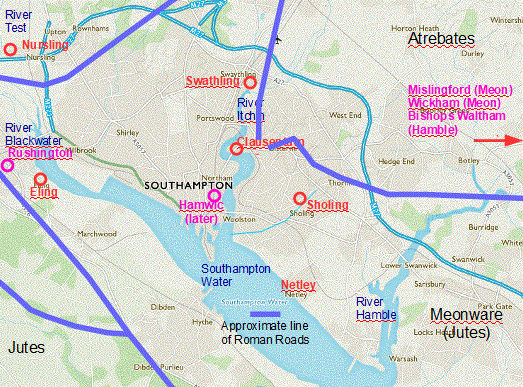
The very limited distribution of early -ing Saxon place names in the Southampton area supports the ASC timeline of very little progress in extending
their territory for some years after the initial landing. As the map below shows there are just four -ing names in this area, a stark contrast to the large numbers in Sussex, where expansion was rapid, leading to many early settlements. [Consider Hensting, NE of this map about 9 miles from Hamwic and south of Winchester, Chilling just south of Warsash and Keeping on the Beaulieu River.] Sussex has perhaps 150 place names including -ing-, of which at least 50 reliably end in -ing or -ings. The small Roman town of Clausentum at Bitterne was taken around 500 and either abandoned or reused [find source and clarify which]. There are more of the later Saxon place names with -ington, -ingham, -ham and -ton over a wider area [plot these on a map too after establishing a credible time sequence]. The Jutes were near neighbours of the Saxons in Jutland, and left us the same place name endings, but there is little suitable landing westwards of Southampton Water until the Beaulieu River and even Lymington is a later name, [check], so attribution of the four Southampton -ing names to the Saxons is relatively secure.
Distribution of -ing place names over Google Earth and Roman Road background (copyright 2018 Google, Image copyright 2018 TerraMetrics)(
The limited extent of very early Saxon settlements ending with -ing and Clausentum, with some later ones too
Other Saxon names: Woodington at East Wellow, Bossington, Houghton in the Test valley south of Stockbridge, Fullerton north of Stockbridge at the confluence of the Test and Anton, Chilbolton opposite, Middleton (near Longparish), Southington, Overton and Quidhampton near the source of the Test, Swampton on the Bourne (tributary of the Test north of Longparish), Charlton and Anton on the river Anton (Andover), then on Pillhill Brook south of Andover: Monxton, Thruxton, Kimpton. Then come back down the Bourne towards Salisbury: Cholderton, Allington, Newton Tony, Idmiston, Porton... Also Pitton, of course.
Tentative Wessex Boundaries in 500 and 508 based on Roman Roads (shown blue), place names, the Anglo-Saxon Chronicles and key sections of later county boundaries
See Anglo-Saxon period 410-1066 for detailed discussion of the map
519 was somewhat of a turning point both for the West Saxons and for the Britons. Cerdic had become king in that year and pressed west across Cerdic's Ford, Charford, on the river Avon. In the battle that followed Cerdic was soundly defeated, although he appears to have gained territory west of the Avon as far as Bokerley Dyke, but further advances in that direction would not be made until Wansdyke was breached in 658, some 140 years later. The Britons had significant defences in the form of Bokerley Dyke and various sections of Grim's Dyke roughly eight miles west of Downton, about half way along the Roman road from Old Sarum to Badbury Rings, and it is suggested that cutting this road was the objective of the raid. The battle has been conflated locally with the battle of Mount Badon (Badbury Rings) described by Gildas and the "peace for a generation" that followed. This seems very plausible, although there are other contenders for the site of this battle. The location of Badbury Rings is significant, standing at the crossing of Roman roads from Old Sarum to the north east, Somerset to the north west, Dorchester in the south west, and the vital British trading port at Hengistbury/Poole harbour to the south.
Bokerley Dyke dates from the Bronze or Iron Age, but was reinstated across the Roman road 4c (Ackling Dyke) in late Roman times, so would very much still have been a serviceable line of defence. It seems to have been a very longstanding tribal boundary, and after the Romans left seems to have been the boundary between the Atrebates to the east and Durotrigies to the west. The Durotrigies also had strong northern defences along Wansdyke from near Bath to the head of the river Avon near Alton Priors, which was finally breached by the West Saxons in 658 as described above. Even though this may have marked the taking of remaining Atrebates territory west of the Avon, they held on at Old Sarum for another 32 years. The line of the Hampshire county boundary suggests that the West Saxons failed to reach Whiteparish in that period too, in which case the Atrebates continuing to farm Witherington Down remains a possibility.
Dorset border with Hampshire - Cerdic's gains west of the Avon from Cerdic's Ford (Charford) to Bokerley Dyke. Roman Roads shown approximately in red
By the time Cerdic and Cynric took the Isle of Wight by force in 530 the whole of the area from Charford to the Sussex boundary and south to the coast was effectively a single area of settlement including both Saxons and Jutes in their respective areas. Cerdic gave his nephews Wihtgar and Stuf charge of the Isle of Wight, although the independent kingdom that developed there would eventually be overrun by the West Saxons in another bloodthirsty episode after 685.
Hill forts and tribal boundaries around 519-525?
After 57 years consolidating their position in Hampshire and the Isle of Wight, the West Saxons finally took Old Sarum in 552 and it is probable that Whiteparish was part of their newly expanded territory. Between 552 and 577 there were further territorial gains against the British to the northeast and northwest: Barbury Castle on the Marlborough Downs in 556, Lenbury, Aylesbury, Benson and Eynsham in 571 (possibly joining forces with the Saxon Gewisse as they took this area) followed by Bath, Cirencester and Gloucester in 577, when it is generally considered that the West Saxons reached the Bristol Channel and cut off land links between the Britons to the north and those in the south, gaining access themselves to the Severn valley and estuary. The battle Fethan Leag in 584 is sometimes linked to Fretherne on the Severn estuary (shown in green on the map below and on the Anglo-Saxons page for reference), but modern scholarship favours a site near Stoke Lyne in northern Oxfordshire. The enlarged Wessex now ran to the Severn on the west and Mercia to the north around Dorchester and the accounts seem to imply a confederation of separate kingdoms within Wessex, overseen by the king of Wessex of the time.
In 591 or 592 Ceol, Ceawlin's nephew and possibly aided by Britons [reference needed], defeated Ceawlin at Woden's Barrow (Alton Priors) and "drove him out". The Durotrige border ran very close to Woden's Barrow, so they would almost certainly have been actively involved here in defending their Wansdyke boundary throughout Ceawlin's advance westwards into the area north of this and now in the battle between Ceawlin and Ceol, when they appear to have sided with Ceawlin - possibly he had promised to respect their boundary? Ceol was a son of Cynric and grandson of Cerdic, as well as nephew of Ceawlin and as such would have been in line as a future king of the Gewissae or even of Wessex itself.
The acquisitions of 571 and 577 had taken Wessex north to the Mercian boundary, and later fighting in this area appears to have been in the form of border disputes between Wessex and Mercia, rather than between the Gewisse and West Saxons, so the battle of 591 at Woden's Barrow may have been the point at which Wessex and the Gewissae fused. It is very striking that at this point Wessex occupied an area very close to that of the Iron Age Belgae and Atrebates tribes immediately before the Roman Conquest. Sussex and Kent likewise mirror closely the Regenses and Cantiaci areas, and together with Wessex each represent an area taken in about 100BC [check date] by invaders from Gaul.
[****working here****]
Expansion westwards along the coast from the river Avon stalled until 658, when the Durotrigies were pushed back to the river Parrett in Somerset [did this include a southern extension though?]. Most, if not all of Dorset was probably taken at the same time [mrf supposition]. Ine (688-726) took the rest of Somerset and also Devon from the Durotrigies, pushing them back to Cornwall. Cornwall finally became a client kingdom of Wessex in 838 under Æthelwulf, and in 839 Surrey, Sussex, Kent and Essex were back under the control of Wessex.
A battle at Ashdown on the north Wiltshire border took place in 661 and the Mercians then pushed south to the Isle of Wight, taking it from Wessex and delivering it to the king of Sussex [name him]. Between 685 and 688 Caedwalla not only took back the Isle of Wight, but also took control of Sussex, Kent and Essex. This didn't last long, and under Ine 688-726 Wessex control of these three kingdoms was lost and as described above, Wessex concentrated for a time on pressing westwards.
During the reign of Ine (688-726) Wessex established the first administrative counties - Devon, Somerset, Dorset, Wiltshire and Hampshire, areas that had been in the making for a considerable time by then.
Mercia twice took control of Wessex, between 730-745 [really 732-752? - check Mercia hegemony map detail] and between 781-802. Cynewulf went on to take Berkshire from Mercia in 758, but not for long as it was taken back in 779. This warring ceased under Beorhtric (786-802), a close ally of Offa of Mercia. Mercia was briefly taken by Egbert of Wessex in 829, but only for a year, and surprisingly he maintained good relations with Mercia afterwards. Wessex in the meantime absorbed the kingdoms of Sussex and Kent in 825. Peace and order was progressively introduced between the Anglo-Saxon kingdoms, but a new threat was looming that would ultimately result in the the survival of only Wessex, from which base the country would ultimately be united as a single Anglo-Saxon kingdom.
Bring the story up to date here to the beginnings of England under Æthelstan (924-939)
Vikings or Danes? These were the same people [reference]. One convention is that raids were carried out by Vikings and settlement by Danes.
Although the Viking attack on Holy Island at Lindisfarne in 793 is generally referred to as the beginning of Viking raids, there was an earlier Viking landing on the Isle of Portland, detailed in Æthelweard's Chronicle and reported briefly in the other versions of [ASC]. Three lost Viking ships landed at Portland Bill. The king's reeve tried to collect taxes from them. They killed him and sailed on. More raids followed, especially in Northumbria, with monasteries a prime target [list of Viking raids, local copy]. In 835 the Vikings overwintered on the Isle of Sheppey. The following year king Egbert fought 35 Danish ships at Carhampton on the north Somerset coast. The raids continued, with the Vikings overwintering on Sheppey in 854 and Thanet in 864. Then in 865 an invading army landed in East Anglia intent
on conquering the four Anglo-Saxon kingdoms of England. By 876 Northumbria, East Anglia and Mercia had been conquered and Wessex was attacked. [Add more detail here.] King Alfred finally defeated the Danes at Edington and the Danelaw was established, with Alfred firmly back in charge of Wessex and Mercia now
included in his territory. The Danes were progressively pushed back and Viking rule ended in England in 954.
The picture is of a marauding Danish army moving from town to town gradually accumulating territory. While it was a large army and therefore
must have drawn supplies from a wide area as it travelled, it seems probable that
the Danes didn't actually come to the Whiteparish area, even though Alfred had been driven back to Somerset before
finally defeating them at Edington, just 26 miles northwest of here.
Danes gradually pushed backwards by the Anglo-Saxons
907 Romsey Abbey was founded by King Edward the Elder for his daughter, Princess Ælflaed, a nun at Wilton who became the first Abbess of Romsey
927 the [?monarchs] of Britain gathered at Eamont in Cumbria to recognise Æthelstan as king of the English
954 Viking rule ended in England when Eric Bloodaxe was driven out of Northumbria
Æthelstan (924-939) and his half brother Edmund I (939-946), Eadred (946-955), Eadwig (955-959), Edgar (959-975),
Edward the Martyr (975-978), Æthelred II (978-1013 and 1014-1016 - see below for the later dates)
994 The Saxon Romsey Abbey complex in Romsey was destroyed by Sweyn Forkbeard and his Viking soldiers during a raid in 994. The nuns, supposedly warned by divine intervention, were able flee to the Nunnaminster in Winchester. [From Britannia.com]
The "Chronicle of John of Wallingford" (c. 1225-1250) records Sweyn's involvement in raids against England during 1002-1005, 1006-1007, and
1009-1012 to avenge the St. Brice's Day massacre of England's Danish inhabitants in November 1002.
Sweyn Forkbeard (1013-1014) became king on Christmas Day 1013 but died just 5 weeks later, then Æthelred II (above) returned from 1014-1016.
In the summer of 1015, Cnut's fleet set sail for England with a Danish army of perhaps 10,000 in 200 longships.[23] Cnut was at the head of an array of Vikings from all over Scandinavia. The invasion force was to engage in often close and grisly warfare with the English for the next fourteen months. Practically all of the battles were fought against the eldest son of Æthelred, Edmund Ironside.
[Confused - sort out into previous paragraph]
Sandwich, Wessex - mouth of the Frome and harried in Dorset, Wiltshire and Somerset. 1016 crossed the Thames and harried Warwickshire and on northwards, then
back to London. Edmund died and Cnut became king of England for 19 years (1016-1035).
Harold I (1035-1040) was the son of Cnut. He was followed by his half brother Harthacnut (1040-42), with whom he had initially shared
England, but who had been abroad for most of this time protecting his other kingdom of Denmark from Norwegian and Swedish invaders.
Harthacnut was followed by Edward the Confessor (1042-1066), again a half brother, who set about restoring the Saxon rule to England. On his death Harold II (Godwinson) (1066), Earl of Wessex, was elected king of England by the Witan in January 1066. The Norwegian king Harald Hadrada had a claim to the throne, but Harold Godwindson defeated him at the Battle of Stamford Bridge in Yorkshire before marching south to meet the 7000 strong army of William of Normandy at the Battle of Hastings.
The remaining sections cover the rest of the historical period from 1066
The earliest known remains of Man in Britain come from Norfolk and Suffolk, dating back some 900,000 years. In the south of England the earliest remains come from Boxgrove in Sussex, from about half a million years ago. Finds in the Whiteparish area are from between 500,000 and 150,000 years ago during the Cromerian Interglacial and then from between 40,000 and 10,000 years ago in warm periods during the Devensian Glacial. After the Channel was formed about 8000 years ago, British culture diverged from that on the continent and people have been present ever since.
The Bronze Age and Iron Age saw a more tangible local presence close to and within the parish of Whiteparish, with plenty of visible signs from this period. About 100 BC the Belgae tribe invaded this area, probably driving out the earlier British people, and similar territorial gains were made by other continental tribes in the Hampshire and Sussex areas, leaving earlier native Britons to the west of Salisbury.
The Belgae tribal area locally became part of the Atrebates territory within
Britannia Prima during the Roman period. After the Romans left in 410 the Atrebates controlled the area until they were overrun by Saxons under Cerdic to become part of what was at the time a very small kingdom of Wessex by 519. Wessex at that time merely consisted of the extreme southwest part of what is now Hampshire, entirely south and west of Southampton Water. In due course Wessex expanded in stages to form the country of England. The Danes drove Alfred back to Somerset and were ultimately defeated at Edington. It would be 1066 and the Norman Conquest before further major changes took place in Whiteparish.
...More to be added here...
Links to more detailed discussion and analysis of various topics above
For a fuller discussion complete with links, references and exploration of other theories and opinions on the historical record see the following pages:


.gif "This map is also shown above - resolve")


.gif "Jutes in Britain in 575")
.gif "Map showing Jutes' probable homeland") ...
....png "An alternative Jutish homeland map")
.png "Viking ship reconstruction at Ramsgate")
.jpg "Map showing the distribution of -ing place names")

.gif "Map showing hill forts and tribal boundaries around 519-525")
.gif "Map showing Wessex expansion and contraction 552-726")


