A Whiteparish local history page from younsmere-frustfield.org.uk
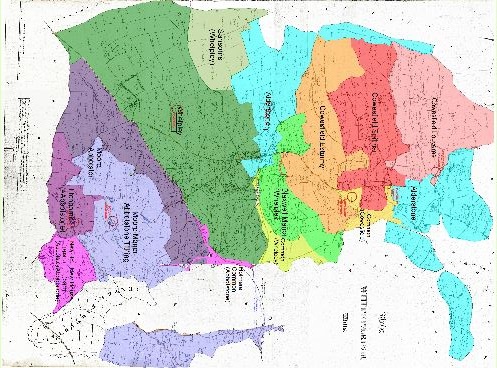
A view of the Mediaeval Structure of Whiteparish - 4 tithings, 8 manors [add tithing boundaries to supplement manor and estate colour banding]
Whiteparish - a village and parish in the southwest corner of Wiltshire that features a village, hamlets, farms, a church and ruined chapel, a local shop and a number of businesses, grand houses and their parkland. The parish and settlement structure reflects its history through the Iron Age, Roman, post Roman and Mediaeval periods. Historical resources include a comprehensive account of the parish and wider Frustfield hundred from 1844 and a contemporary Tithe Map of 1842, an 1804 enclosure map and census returns at ten year intervals from 1841.
This page summarises the evolution of the structure of the parish, while the rest of the website expands this story. Links on this page provide one way of reaching topics of interest within the overall page organisation and the contents bar on the left provides another.
Several past and present historical land divisions will be important in explaining the present parish structure, so these are introduced first. Important historical ones are the Hundred of Frustfield, of which the parish is roughly half, the four church Tithings of Alderstone, Whelpley, Cowesfield and Abbotstone, and within them the eight manors that provided the mediaeval basis of life, law and order. Ecclesiastical parishes and civil parishes, district and county, which will be familiar to many readers, are also described - see here [extend link to the correct point(s) on the page].
After introducing the structural layout of the parish, the rest of this page runs quickly through the historical periods that contribute to the parish, village and hamlets we see today, giving a broad sketch of how what we see relates to the way it developed and linking to more detailed sections.
The page is organised as follows: [turn the bullet points into links down the page rather than direct]
Before the coming of the Romans, Iron Age boundaries were typically rivers, so it is no surprise to find that the Salisbury Avon was one such. Curiously, perhaps, this boundary not only survived to re-emerge after the Roman period, but lasted for a while in the initial Saxon settlement, when it formed the western boundary of Wessex in this area from 525 for a century. The Saxons arrived in the Southampton area in 495 and had had established themselves across Hampshire immediately south of Frustfield by 519. They are credited with establishing our county boundaries, starting in this initially small kingdom of Wessex, which spread only slowly across what is now the county of Hampshire before expanding progressively into Wiltshire, Somerset, Devon, and Dorset by 694. With the Saxons too came the Hundred boundaries, sometimes containing as little as a single manor. Here, though, the Hundred is large containing eight manors within Whiteparish, as well as Landford, Melchet and a large part of what is now Redlynch.
Christianity in this area was swept away after the Romans left, but after its re-establishment under the Saxons, this hundred contained five [expand] church Tithings, four of them in Whiteparish, with a church or chapel in each serving from one to a few manors. The church structure settled to a main church with outlying chapels together serving a single Ecclesiastical Parish, and this is the origin of the parish of Whiteparish. In 1866 civil parishes were defined, based broadly on the ecclesiastical ones. These effectively replaced the Hundred land divisions, and with modifications down the years still serve this purpose today. The manor structure survived until the enclosure acts. Much of the parish had already been enclosed and allocated to individual ownership by then, and the enclosure acts completed this process, effectively ending the manorial system. Manors continued to be traded for a time, but were progressively separated from what had been the manor farm lands, and no longer brought the power that the mediaeval Lord of the Manor enjoyed. See Wessex church history.
An introduction is given to what is known of the way this part of England came into being through the ages, showing a geological structure that relates closely to land use both past and present, and the effects of changing climate in the historical period. See the Geology and Climate and Weather pages.
What is known of the Stone Age (Palaeolithic, Mesolithic and Neolithic) and Bronze Age locally is summarised, with a wider national view giving a flavour of what might have been going on in Whiteparish at the time.
The Iron Age, leading up to the coming of the Romans, provides what we commonly think of as the period of the Ancient Britons or Celts. The arrival of Julius Caesar in Northern Europe from 55 BC provoked a migration of Iron Age tribes from the continent into southern England, and it was at this time that the Belgae occupied this area and subsequently expanded northwestwards to the Bristol Channel, driving the native Britons north, west and east into neighbouring areas. To the west over the Salisbury Avon at the time of the Roman invasion were the Celtic Durotrige tribe, while to the east across what is now the Hampshire/Sussex boundary, were the Regnenses, another Celtic tribe. To the north the Atrebates were another Belgic tribe. It is possible that the Regnenses were, at least in part, Celts driven from this area who in their turn had driven the Atrebate settlers northwards away from the coastal region. [Provide links]
While the Romans themselves don't appear to have come to Whiteparish, there are Roman remains in the Dun valley to the north and at Downton [add links]. In a parallel with the Romano-British presence on the Downs between Brighton, Lewes and Newhaven, the continued presence of the Iron Age peoples as Romano-British left a mark on the parish that stretches along the ridge from Witherington Down and Pepperbox Hill towards Dean Hill. During the Roman period the Romano-British continued to contribute towards the British export of cereal crops to the continent. Whiteparish fell within Britannia Prima, the Roman province that covered Wales, the west Midlands and the southwest. The boundary locally between this and the southeast area Caesariensis Maxima fell, perhaps predictably, along the Hampshire/Sussex border. See Romans.
After the Romans left our shores in AD 410 this area was part of Atrebatia, the Atrebates area now much larger and stretching east and west from the Solent. Life is unlikely to have changed instantly for the inhabitants of the parish. However, with the loss of Roman military might, it wasn't long before the Saxons started to expand opportunistically into the weaker administrative areas of the country. This was one such area, and the initial area of Wessex was in place by about 500AD, leading to the beginnings of the land use and structure we see today.
With the arrival of the Saxons and Jutes in the Isle of Wight, Meon valley and around Southampton, land occupation and division started to develop more strongly along the lines we are familiar with today. Wessex expanded outwards from Southampton as a small "kingdom" between Southampton, Winchester and the river Avon, and remained so for a generation. The Jutes that settled the Isle of Wight and southern New Forest areas were related to early Saxon settlers in this area, initially appearing to lead to a peaceful coexistence with the early Wessex, but that didn't prevent Cerdic, one of the original invaders at Southampton, subsequently invading and taking the Isle of Wight [add links]. The Meonware in the Meon valley also became part of early Wessex in this period of territorial stagnation. After 550 the northern border of Wessex started to move north, joining up by 575 with the Gewissae in the Oxford area, and then progressively across much of England. In later tussles the Danes revisited the area on several occasions before the Saxon structure settled down to the pattern we see [add links to King Alfred at Winchester].
Christianity reached this area in Roman times and was well established in Britain by 353 [link - wrong link]. West of the Salisbury Avon and possibly east of the Hampshire/Sussex boundary it has continued without interruption to this day. Here, however, pagan Saxon invaders led by Cerdic and Cynric swept Christianity away at some point after 495 for a time before it was re-established in 635, when Cynegils was baptised by Birinus with Oswald, king of Northumbria, as his godfather [link]. The missionary centre of activity started by Augustine in Canterbury had stalled and the then Pope blessed a new start in Wessex, still at that time encompassing only the area of Wiltshire [check]. Unlike Canterbury this formed close links with the British church and flourished and spread rapidly across the country, resulting in a new base at York, still today one of our two Archbishoprics. It was through events within the church leadership in Wessex that church power shifted back to the less successful Canterbury, resulting in its supremacy over York in our times [add links].
As Wessex continued to expand the manors and tithings settled into a pattern we recognise within the landscape. Later, the coming of the Normans provided a useful snapshot in the form of the Domesday Book, but did little to change the pace of life, other than for those displaced in the higher layers of society (Domesday Book).
The manors of the early mediaeval period began to see change as the population gravitated towards the centre of what was to become Whiteparish village, where a key set of manors and tithings met along boundaries that met close to the church of Alderstone. They were followed by the Lords of the Manors, who moved their own houses into the village. Later still the Lords of the Manor moved back out onto their manor farmland, setting up grand houses and parks that still influence the lie of the landscape today. As mediaeval structures crumbled, farmland was enclosed and divided between tenants and remaining manor lands were sold on separately from the manors themselves. With the abolition of tithes and serfdom, the Tithings, Manors, the Hundred and all that went with them dissolved progressively. The Lords of the Manors were gradually replaced in their grand houses by the new Captains of Industry and important figures from the armed services. Many people moved out onto their own land holdings, or those they rented, and the present structure of farms developed. Some final adjustments in parish boundaries occurred in the nineteenth century, leaving us with the structure of farms, village and hamlets we now see. Road improvements followed progressively, from the A27 and A36 turnpikes starting in 1753 to the more modern enhancement of transport links most evident in the 1970s (roads).
As this website has grown over the past 24 years, the two suggestions below for exploring its pages have progressively become less useful, although both have been retained. An alphabetic index has now been added (also at the top of the left column, or if there isn't a left column see the note at the end of this paragraph). This links to all pages except those closely linked to living individuals, and shows clearly which ones are available on the web and which I have not yet uploaded. Please ask if you would like particular pages to be made available. A subsidiary alphabetic index lists all house names in the village, with links where properties are covered within the website. This is principally of use to me by providing quick access to the locations of named properties and to their earlier names where these have changed, not always easy in a village of this size. Both links are near the top of the contents column to the left. If you have arrived on this page using a search engine, this link or the Whiteparish local history links provided at the top and bottom of this page will open a new window that includes the contents column.
The links provided under the headings within the text above on this page provide an earlier framework from which to explore much of this website and to burrow into greater detail on topics of interest. There is also a more detailed version of this overview page that you can see at Whiteparish through the ages, which in turn links to more detailed pages under each sub-heading.
The contents column in the left frame of this page provides another way to access sections and pages. It starts with a link to the alphabetic index, then there are links to other towns/villages I have covered followed by links to recent, quick access and private pages. Below this is the main contents list to a selection of pages. Finally, at the bottom there is a block of links to reference material. As mentioned above, if the contents column isn't displayed, then click this link to open a new window that has the contents column visible.